PUBG - TPP VS FPP, Initial Stats Exploration
Posted by Burj on Sun 24 May 2026. Maps, Analysis
The switch from first-person (FPP) to third-person (TPP) mode in PUBG esports has certainly caused some spirited discussion within the community. With the completion of PUBG Global Series 2026 Circuit 1, the first major international TPP mode tournament to be finished since the switch (at the time of me writing this, at least!), I thought it would be interesting to dive into the data and see if we can identify any changes in the way competitive games are being played.
To do this, I've analysed telemetry data for the 69 TPP games played during PGS 2026 Circuit 1, including Series 1, Series 2, and the Series Final. To see how this compares to FPP gameplay, I've extracted data for the PUBG Global Championship 2025 (72 games) and PUBG Global Series 10 2025 (36 games), the final two international FPP tournaments. I've also pulled out data for PUBG Global Series 7 2025 (36 games). With PGS 2026 Circuit 1 (TPP) and PGS 7 2025 (FPP) being the first international events of their respective years, this allows for a more "like for like" comparison between FPP and TPP tournaments. This reduces the chance that differences in gameplay style are actually down to factors such as a need (or lack of need) for PGS points, rather than the different perspective modes.
While PGS Circuit 2 is now underway, it hadn't begun when I started writing this post, and so is not included here.
| Tournament | Erangel | Miramar | Rondo | Taego | Total |
|---|---|---|---|---|---|
| PGS 2026 Circuit 1 | 21 | 21 | 15 | 12 | 69 |
| PGC 2025 | 24 | 24 | 12 | 12 | 72 |
| PGS 10 | 12 | 12 | 6 | 6 | 36 |
| PGS 7 | 12 | 12 | 6 | 6 | 36 |
| Total (FPP only) | 48 | 48 | 24 | 24 | 144 |
| Total (FPP & TPP) | 69 | 69 | 39 | 36 | 213 |
You'll notice that PGS 2026 Circuit 1 sees proportionally more Rondo and Taego played compared to other tournaments. Comparing overall average statistics from these tournaments is therefore not quite a like-for-like comparison, although it does provide an accurate view of how the tournaments were actually played. Because of this, I've also pulled out stats for Erangel and Miramar specifically, the two most commonly played maps.
This article contains just my initial thoughts and experiments around how we could measure differences in FPP and TPP gameplay. If you have any suggestions for other things you'd like to see measured, just get in touch and I'll see what I can do.
Game length
It has been suggested that TPP leads to 'slower' games compared with a first-person perspective. To explore this, I first found the length of each game in my dataset, and averaged this by tournament.
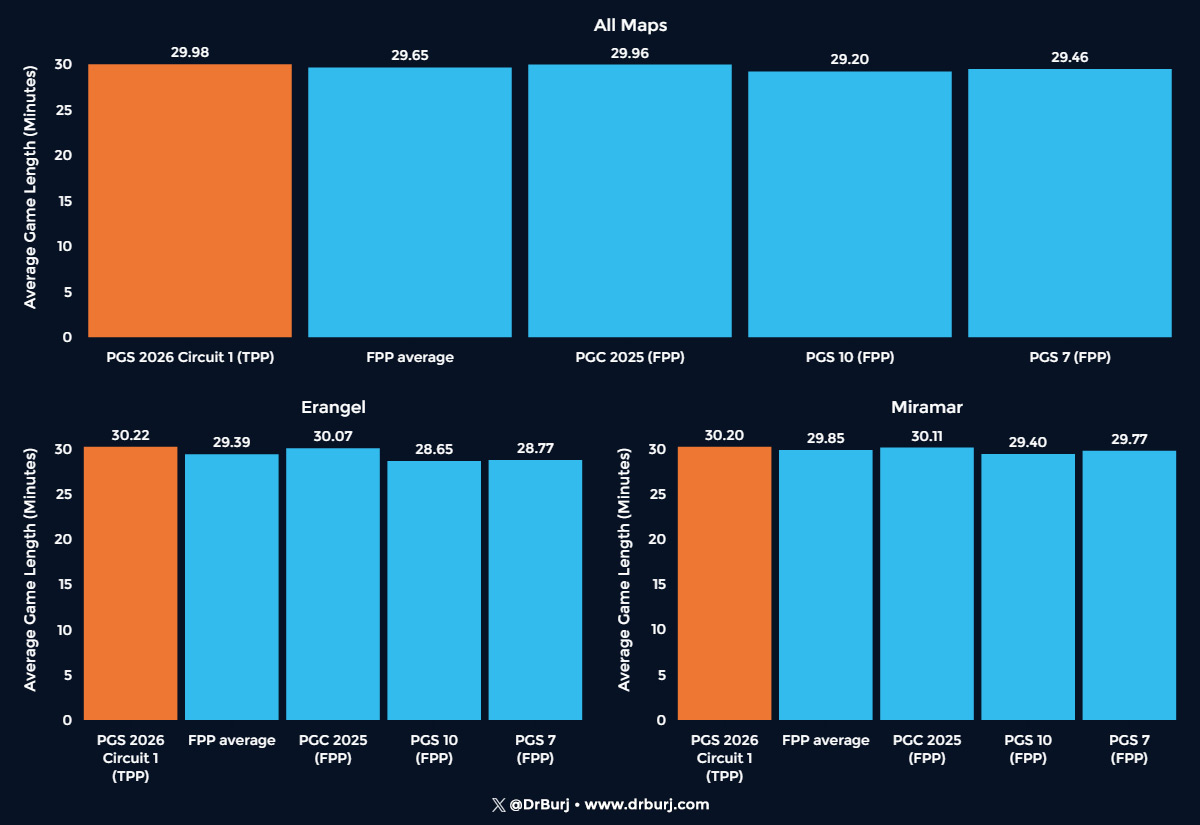
TPP mode games are indeed lasting longer on average than FPP ones, although the difference is very small. Across all games on all maps, TPP games lasted on average 32 seconds longer than FPP ones in my dataset. For Erangel specifically, the average TPP game length was 62 seconds longer, while for Miramar it was 35 seconds longer.
Players alive
The small change in game length is perhaps not that surprising, given the shrinking circle forces most games to end by phase 9 or 9.5, regardless of playstyle. To instead explore what's actually happening during these games, I next calculated the number of players alive during each phase.
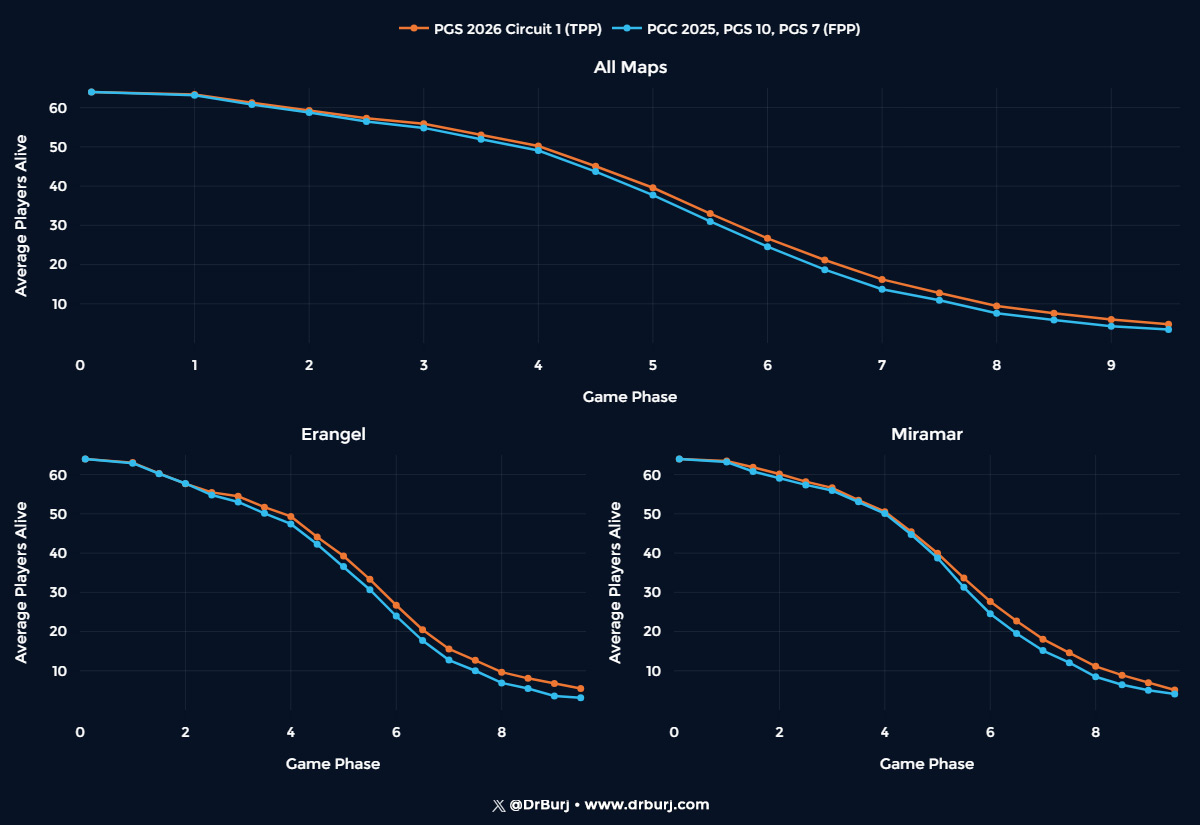
TPP matches have on average more players alive than FPP ones, beyond the earliest phases of the game. Differences in the early game are small, but become more noticeable as games progress, with more players surviving into end game circles. On Erangel for example, TPP games in my dataset had on average 9.6 players alive at phase 8, while FPP games had an average of 6.7.
Movement speed
Of course, TPP games being 'slower' can mean many things. In addition to game length and kills, I've also had a look at player movement. First, I calculated average "movement speed", as the total distance moved by a player as recorded in the game telemetry (excluding parachuting and freefall), per second the player was alive (therefore accounting for differences in average game length).
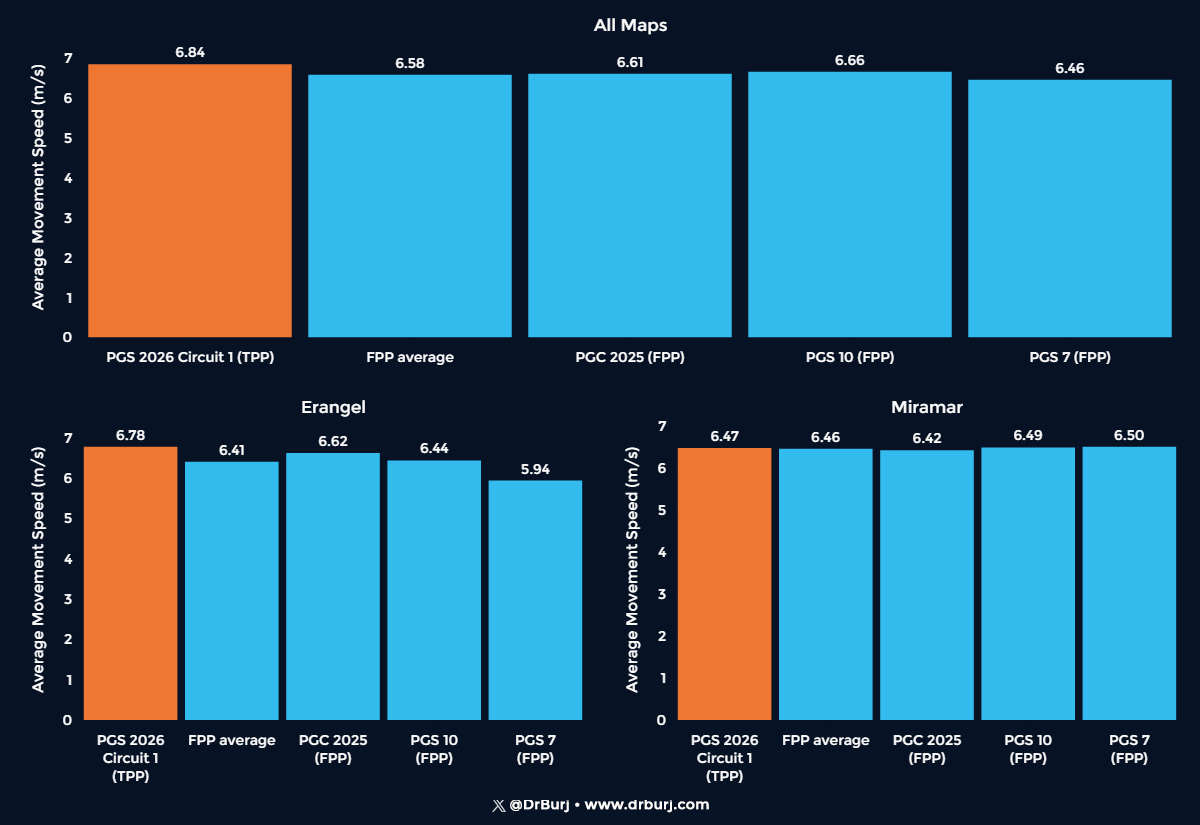
Results here are more mixed. Overall, TPP games in the dataset actually have a slightly higher movement speed on average compared with FPP games. That is, players in TPP are moving around more over the same periods of time than players in FPP games did. The difference is however very small, and on Miramar specifically both PGS 7 and PGS 10 (FPP) had a greater average movement speed than the third-person perspective PGS 2026 Circuit 1. It is also important to remember that this metric will also be influenced by other factors, particularly circle shifts dictating the distance players need to move.
Time in one spot
One common suggestion is that TPP mode leads to more instances of camping, particularly camera peeking around terrain to gather information (wall licking!). To start to explore this, I first divided each map into 10 metre wide hexagons.
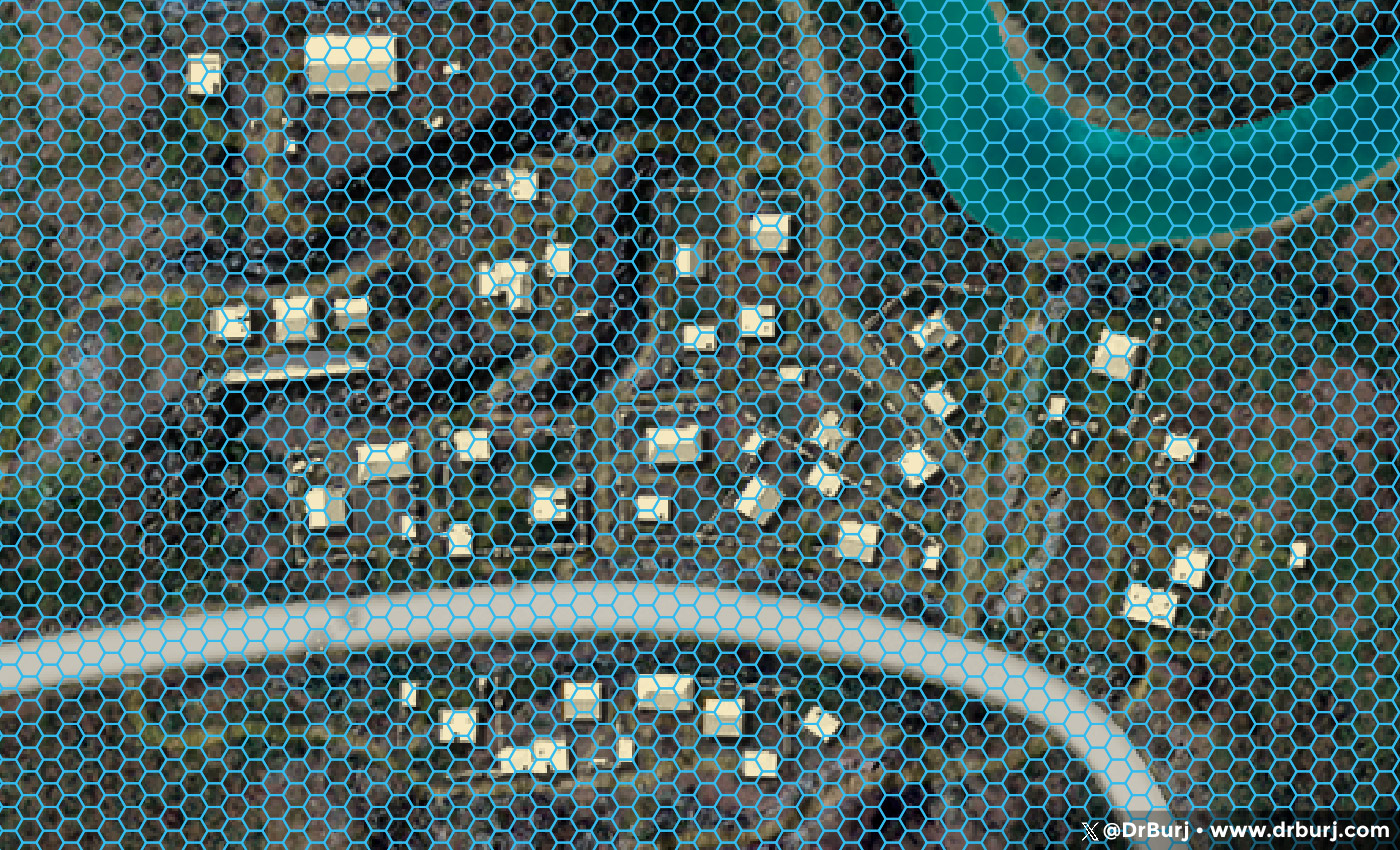
PUBG telemetry data records player positions every 10 seconds. Each time a player location was recorded, I noted the hexagon it was within.
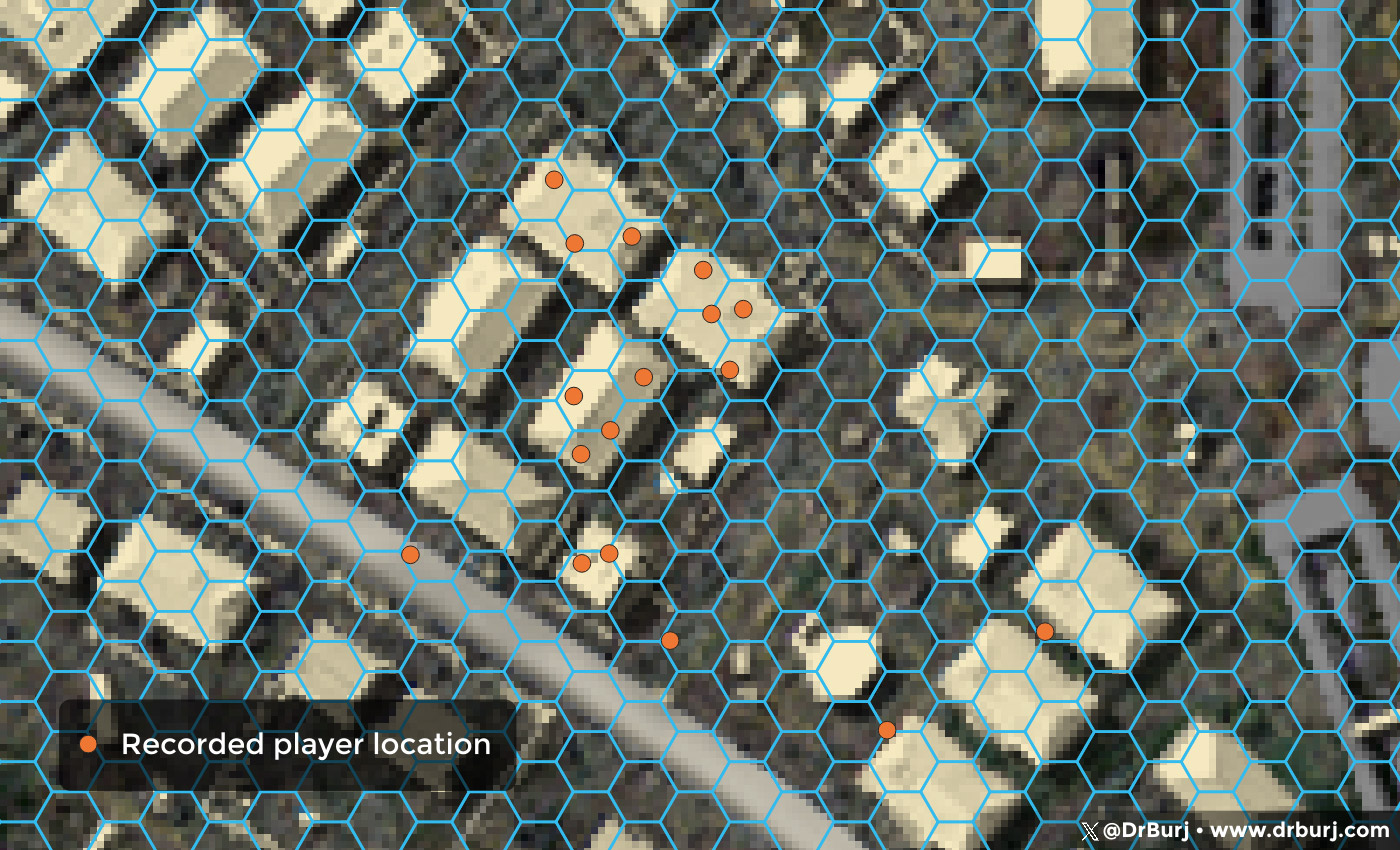
When a player's recorded location was within the same hexagon 3 or more times in a row (30 seconds plus), this was noted. This suggests the player was holding the same position for an extended period, potentially camping. Finally, I divided this estimated 'camping' time by the player's total survival time, providing a simple approximated proportion of time spent holding positions vs time spent moving around the map, accounting for differences in total time alive. This obviously isn't a perfect measurement, but it's a start.
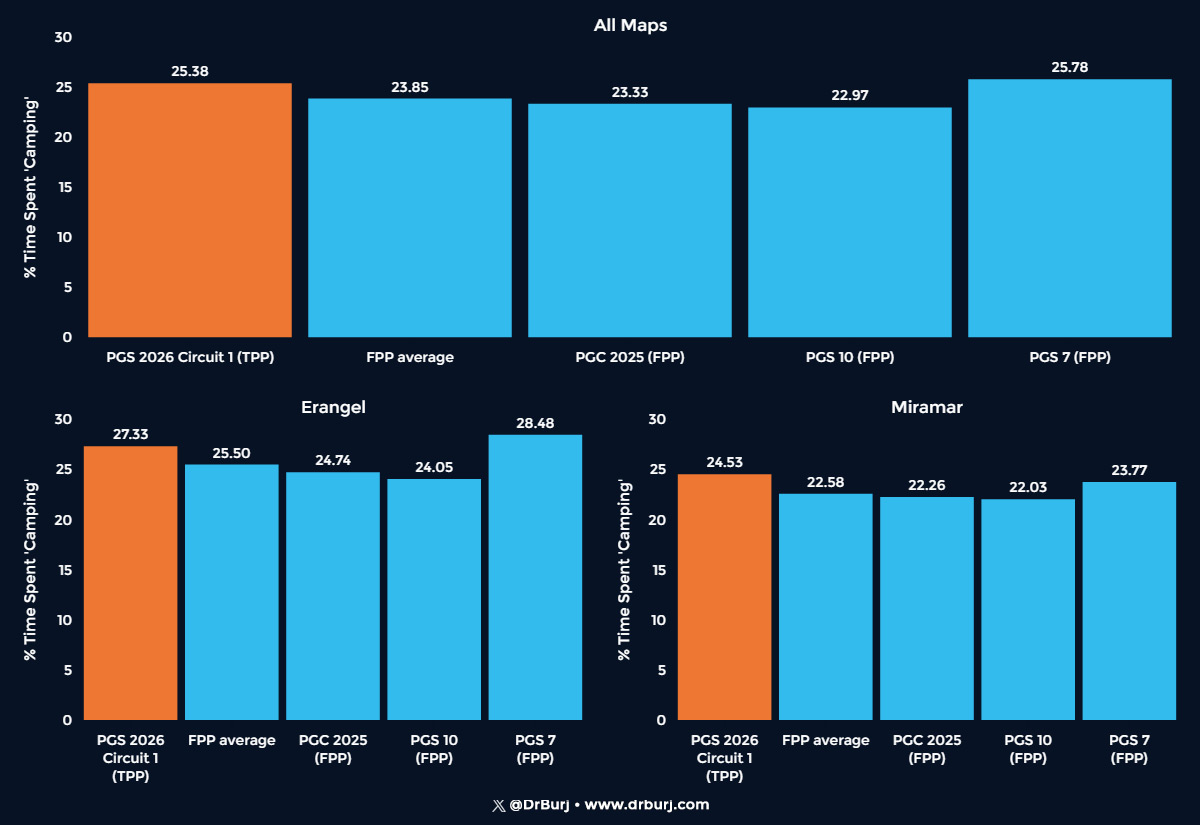
Using this approximate metric, TPP games have on average a slightly greater proportion of time time recorded as camping compared with the FPP average, although the difference is small. PGS 7 (FPP, and the first tournament of 2025) does however come out highest of the tournaments analysed when including all maps played, and Erangel specifically.
Takeaways
There are some noticeable differences between average TPP and FPP tournament games for some metrics, although these are typically small. Recent TPP tournament games are, on average, slightly longer, with more players alive throughout mid and late-game phases. Differences in player movement are more mixed, with players typically moving slightly more per unit time alive, but with slightly more instances of camping locations, compared to some (but not all) FPP tournaments. It's important however to remember that these metrics will also be impacted by other factors, particularly random circle locations dictating how and where players move, and so some differences will simply reflect normal tournament-to-tournament variations.
It will be interesting to see if similar results are seen for PGS 2026 Circuit 2, or if statistics start to change as players gain more experience with TPP gameplay. These stats and graphs are also just my initial ideas. If there's any other data or statistics you'd like me to explore, just let me know and I'll see what I can do!
Giveaway
To say thanks for stopping by the site, I'm giving away a Steam gift card. Enter the giveaway here.
Interested in esports geography?
Get an occasional email update when I publish new articles or analysis worth sharing. You can unsubscribe at any time.
(You may need to check your spam folder).